

New research from 1,500+ UK business leaders
92% of Businesses Use AI. Only 8% Trust It.
That’s The Big AI Secret.
New research from 1,500+ UK business leaders reveals what’s really holding companies back
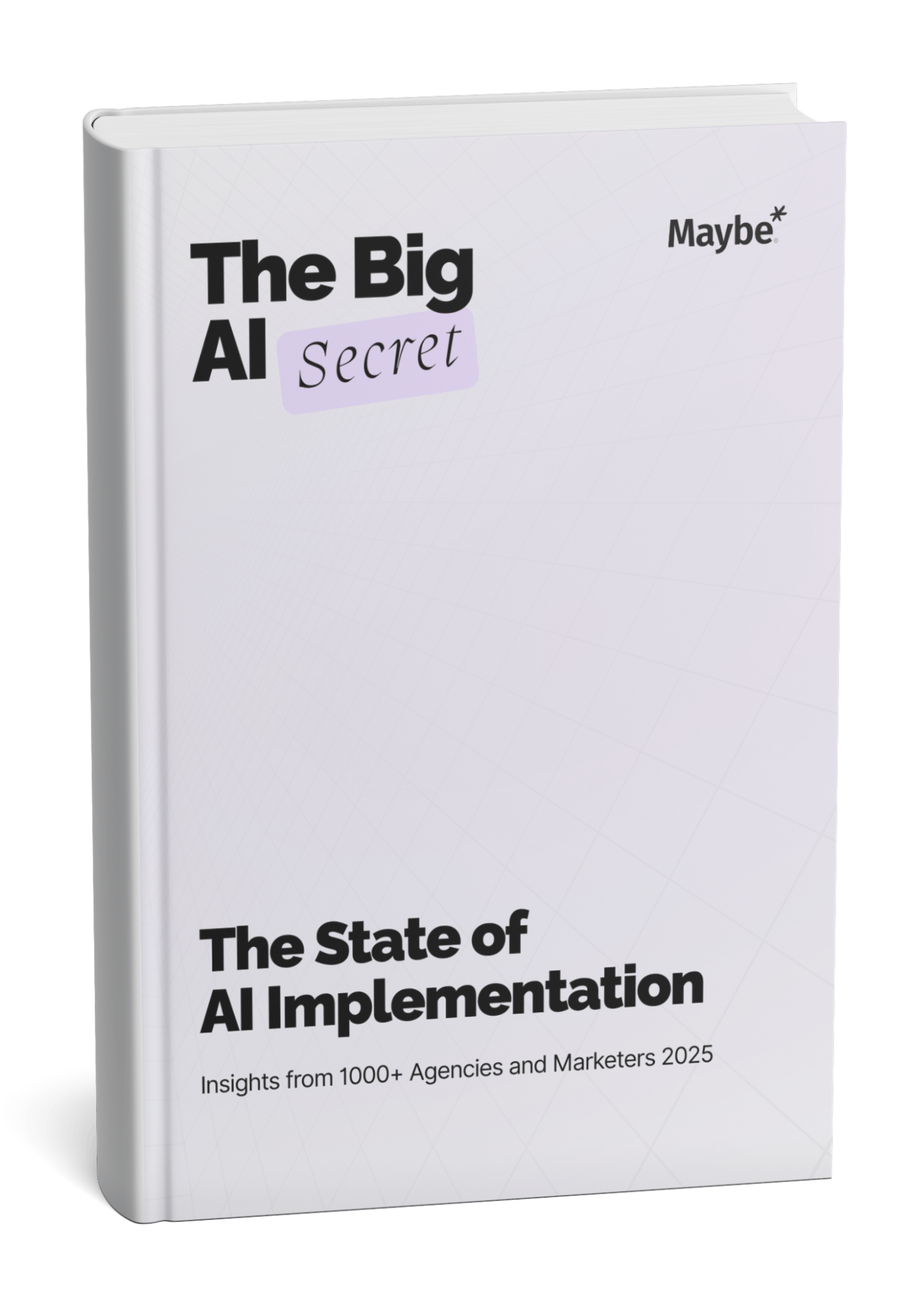
Published November 2025 | Validated against Stanford, McKinsey, BCG benchmarks | 130-page Whitepaper with sector benchmark
The Integration Gap
We've interviewed 1,500+ senior marketing and business leaders. The pattern was consistent: high adoption, low integration. Companies buy tools faster than they connect them. That gap has a multitude of operational issues and measurable costs.
Where The Waste Comes From
Every disconnected tool costs you real margin. Here’s where it disappears and where you can win it back.
Cross-validated against Stanford HAI AI Index 2025, McKinsey State of AI Survey 2025, BCG AI at Work Report 2025
Waste Calculator
Curious what the integration gap costs your team? Enter your details below and let the Big AI Secret calculate it.

The full story behind the UK’s AI integration gap and how to close it.
SECTION ONE
The Real Pain Points of AI Adoption in Business
Companies running 12+ disconnected AI tools report 3.2× higher operational friction than those with integrated stacks.
Finding
Fragmentation Is the Silent Profit Killer
Why This Matters
The problem isn't the tools themselves. It's the space between them. Every time data moves manually between systems, every time context is lost switching platforms, every time duplicated work happens, the margin erodes. Mid-market teams waste an average of 18 hours per week on manual bridges between AI tools.
What High-Performers Do Differently:
Treat integration as a strategy, not IT. Audit stacks quarterly, map data flows, cut redundancies. One retail CMO said: “We went from 14 tools to 6 connected ones. AI ROI doubled in 90 days.”
SECTION 2
Breaking Through the Complexity Barrier
68% of organisations say their AI stack grew faster than their ability to manage it. But here's the insight: companies that reduced their tool count by 30%+ while increasing integration saw 45% ROI improvement within 6 months.
68%
Can’t manage AI stack growth
45%
ROI improvement after integration
Finding
Simplification Beats Innovation Every Time
Why This Matters
Complexity is expensive. Not just in licensing costs, in cognitive load, training overhead, and decision paralysis. Boards view this as an agility crisis: the more tools you have, the slower you move. High-complexity organisations take 2.3x longer to respond to market shifts than simplified ones.
What High-Performers Do Differently:
They follow the "6-tool rule": no more than 6 primary AI platforms, all connected. They choose tools that integrate natively rather than best-of-breed standalone solutions. They measure "time from insight to action" as their North Star metric.
Learn how simplification, not more tools, delivers the fastest ROI gains.
SECTION 3
The Human Element: Leadership, Culture, and Integration
AI transformation isn’t driven by technology; it’s driven by people. When leaders model, integrate, and celebrate AI use, it shifts from a toolset to a mindset that reshapes culture and accelerates results.
Finding
C-Suite Adoption = 60% Higher Success Rates
Why This Matters
AI adoption isn't a technology challenge, it's a change management challenge. When the CEO shares how they use AI in their weekly update, when the CFO shows AI-generated insights in board meetings, and when the CMO publicly credits AI for a campaign win permission spreads. Teams stop asking "am I allowed?" and start asking "how do I get better at this?"
What High-Performers Do Differently:
They make executive AI use transparent and celebratory. They share prompt templates that leadership teams use. They normalise failure ("here's what didn't work for me this week"). They include "AI maturity" in leadership KPIs. One CEO told us, "I send a weekly 'AI win + AI fail' email. It changed everything."
The Cultural Signal: In Transformer-stage companies (top 5-10%), board agendas include standing AI updates not as IT reports, but as strategic capability reviews.
SECTION 4
The AI Dilemma: Quiet Wins, Loud Worries
7 in 10 organisations report measurable ROI from AI adoption, yet only 38% communicate this externally. The fear/reality gap is massive: 61% worry about brand perception, but 84% of customers expect companies to use AI for better service.
Finding
70% See ROI, But Only 38% Talk About It
Why This Matters
The narrative lags behind the reality. The media focuses on existential risk. Boardrooms worry about reputational damage. But customers want faster responses, personalised experiences, and better products—all AI-enabled. The companies hiding their AI use are missing a competitive differentiation opportunity.
What High-Performers Do Differently:
They flip the narrative: "AI-powered" becomes a trust signal, not a risk. They share how AI improves accuracy, reduces errors, and speeds response times. They're transparent about human oversight. One financial services firm increased customer satisfaction by 18% simply by being open about AI-assisted support.
Early adopters who communicate openly are building market positioning while others hide. In B2B especially, buyers increasingly ask: "How are you using AI to serve us better?"
Find out why most brands hide their AI success and what early communicators gain.
SECTION 5
The Security Imperative: Balancing Innovation with Protection
Companies with formal AI governance frameworks report 30% lower compliance overhead and 23% faster innovation cycles than those governing ad hoc. Counter-intuitively, more structure = more speed.
Overhead
Speed
Finding
Governance Frameworks Reduce Risk AND Increase Speed
Why This Matters
Most organisations treat governance as a brake on innovation. High-performers treat it as an accelerator. Clear policies on what data can be shared, what content needs human review, what use cases are pre-approved these remove friction, not create it. Teams stop asking permission and start moving within boundaries.
What High-Performers Do Differently:
They build "guardrails, not gates." Their governance frameworks answer: What data is safe to share? What outputs need human review? What approvals are required for different use cases? They train teams on why policies exist, not just what rules are. They update frameworks quarterly as AI capabilities evolve.
The ROI Pattern: Well-governed organisations see 40% fewer security incidents and 50% less shadow IT (teams buying tools without approval). Governance becomes a competitive advantage.
SECTION 6
Tool Overload vs Strategic Implementation
AI adoption delivers early gains—but complexity grows fast. Once teams exceed 10 disconnected tools, inefficiency compounds, costing an average £18,000–£32,000 per tool per year in wasted effort and overlap.
The 10-Tool Threshold
Minimal waste
critical
without consolidation
clear strategy
Finding
The 10-Tool Threshold Where Waste Accelerates
Why This Matters
Every organisation in our study passed the 10-tool mark. Most didn't realise it. Marketing has 3 AI tools, Sales has four, Operations has five. Suddenly, you're at 12 individual tools without a coherent strategy. Each tool adds value individually but subtracts value systematically.
What High-Performers Do Differently:
They conduct annual "AI stack audits"; mapping every tool, every user, every integration point, every redundancy. They calculate "cost per use case", not "cost per tool." They consolidate aggressively: one agency went from 17 tools to 8 and saved £124,000 annually while improving output quality.
The Strategic Shift: High-performers think in "AI platforms" not "AI tools"—choosing solutions that solve multiple use cases rather than accumulating point solutions.
Identify the 10-tool threshold where waste accelerates and how to stop it.
SECTION 7
The Hidden Cost of Disconnected AI
AI inefficiency isn’t theoretical; it’s quietly draining profit. Across mid-market and enterprise teams, invisible friction between tools erodes between £200,000 and £1.6 million in margin every year.
Where the Waste Comes From
Based on 1,000+ UK business leaders
Finding
£200k-£1.6m in Invisible Margin Erosion
Why This Matters
This isn't hypothetical waste; it's a measurable, recoverable margin. When we showed CFOs these calculations, the most common response was: "I had no idea it was that expensive." The waste is invisible because it's distributed: 30 minutes here, a duplicate license there, a manual export/import that "only takes a few minutes."
What High-Performers Do Differently:
They measure integration as a financial metric. They track "AI cost per output" across departments. They treat every manual handoff as a margin leak. One B2B SaaS company recovered £340,000 in year one simply by connecting their AI tools with no new technology purchased.
The Board Conversation: This is an EBITDA issue, not an IT issue. Integration = margin improvement = enterprise value creation.
SECTION 8
From Experimentation to Transformation
Most companies use AI daily, but few can prove its value. Our research shows that when teams measure integration-specific metrics, ROI compounds fast, typically 3–4× returns within just 90 days.
What Gets Measured
Finding
The 90-Day ROI Window for Integrated AI
Why This Matters
The gap between "using AI" and "proving AI value" is a measurement discipline. High-performers instrument their AI usage the same way they instrument their marketing funnel or sales pipeline. They track before/after metrics. They A/B test AI vs manual processes. They quantify everything.
What High-Performers Do Differently:
They establish "AI ROI dashboards" at the executive level. They link AI metrics to business outcomes (not just usage stats). They celebrate measurable wins publicly. They sunset initiatives that don't show ROI within 120 days.
The Investor Impact: Companies with quantified AI ROI see valuation premiums in M&A and funding rounds. Buyers increasingly ask: "What's your AI-driven efficiency ratio?"
See how integrated teams achieve 3–4× ROI within 90 days.
SECTION 9
Cross-Sector Insights: Industry-Specific Adoption Patterns
Every industry has its AI front-runners, but the real separator isn’t adoption speed; it’s integration. From agencies to retail, the data shows a consistent truth: connected systems outperform fragmented ones across every sector.
AI Integration & ROI by Sector
Finding
Every sector has AI Leaders, but integration separates them all.
Why This Matters
Late movers aren't necessarily losing. Professional Services firms show the highest ROI once they integrate, proving that thoughtful, strategic adoption often outperforms rushed experimentation. The sector you're in matters less than how you connect the pieces.
What High-Performers Do Differently:
Across all sectors, top performers share three traits: they prioritise cross-departmental integration over tool accumulation, they align AI strategy with sector-specific workflows (agencies focus on creative iteration; retail on personalisation; SaaS on customer success), and they learn from adjacent industries rather than waiting for sector consensus.
The Pattern: Fast adopters get early wins. Late adopters with strong integration get sustained ROI. The middle experimenting without connecting ends up burning the budget without building an advantage.
SECTION 10
The Democratisation of AI: Power to the Operators
AI innovation has shifted from IT departments to business teams. No-code platforms are driving a new wave of speed, ownership, and creativity, giving every team the power to build, test, and scale AI use cases in days, not months.
Impact of No-Code AI Agents
Finding
No-Code AI Agents Shift Innovation from IT to Business Teams
Why This Matters
The traditional model: Business team identifies need → IT builds solution → 6-month backlog → solution finally ships → requirements have changed.
The new model: Business team builds solution → ships in days → iterates based on results. The innovation cycle compresses from quarters to weeks.
What High-Performers Do Differently:
They democratise creation while centralising governance. Anyone can build an AI Agent, but it must operate within security/brand frameworks. They establish "AI champions" in each department; not ‘IT’ people, but ‘power users’ who utilise AI to help colleagues. They treat AI literacy as a core competency.
The Balance: Empowerment without governance = chaos. Governance without empowerment = stagnation. High-performers nail this balance through clear frameworks + accessible tools.
Discover how no-code AI is shifting innovation from IT to the front lines.
SECTION 11
The Future of Work: AI Agents as Collaborative Partners
When AI becomes a true collaborator, work gets lighter and people get happier. Teams using AI Agents as partners, not replacements, see less admin, more creativity, faster strategy, and higher satisfaction.
The 25/40 Rule — Human + AI Performance Lift
Finding
The 25/40 Rule — Less Admin, More Creation
Why This Matters
This isn't about replacement, it's about elevation. When AI handles research compilation, data formatting, first-draft generation, and repetitive analysis, humans focus on judgment, creativity, strategy, and relationships. The work becomes more valuable and more enjoyable.
What High-Performers Do Differently:
They pair every AI Agent with a clear human role:
"AI drafts, human refines."
"AI researches, human decides."
"AI monitors, human intervenes."
They frame AI as a junior colleague - capable but requiring oversight. They train teams on "AI collaboration skills": prompting, reviewing, and iterating.
The Productivity Paradox: The Productivity Paradox: Teams working with AI Agents outperform teams trying to do everything manually or trying to automate everything. The sweet spot is a collaborative partnership.
SECTION 12
The AI Implementation Roadmap: From Chaos to Competitive Advantage
High-performers follow a disciplined 3-phase approach that compresses traditional 12-month implementations to 12 weeks.
ASSESS →
CONNECT →
DEPLOY
PHASE 1: ASSESS (Weeks 1-3)
- Audit current AI tool stack (what, who, cost, usage, integration level)
- Map data flows and identify disconnection points
- Calculate the current waste baseline
- Benchmark against sector/maturity peers
PHASE 2: CONNECT (Weeks 4-8)
- Consolidate redundant tools (typically 25-40% reduction)
- Establish integration architecture (API connections, data flows, unified interfaces)
Build governance frameworks (security, brand, approval processes)
- Train teams on integrated workflows
PHASE 3: DEPLOY (Weeks 9-12)
- Launch high-impact use cases first (quick wins build momentum)
- Measure integration-specific ROI metrics
Iterate based on results
-Scale successful patterns across departments
The Board-Level Insight: This isn't an IT project; it's a strategic capability build. Integration directly impacts EBITDA, valuation, and competitive positioning. 90 days to 2.3x faster decisions. Traditional implementations: 12 months • This framework: 12 weeks
Get the 12-week roadmap transforming AI integration into EBITDA growth
For Leaders: The Strategic Choice
You have two paths. The research proves which path works.
This experience shows you what it feels like.
PATH 1: DISCONNECTION
Buy more tools as needs arise
Let teams choose their own solutions
Hope for organic integration
Result: £200k-£1.6m annual waste, declining competitive advantage
PATH 2: INTEGRATION
Audit and connect what you have
Establish governance frameworks
Train teams on integrated workflows
Result: 3-4x ROI in 90 days, 3-5% margin improvement
Get The Full Research
130-page whitepaper with detailed findings, sector benchmarks, implementation frameworks, and quarterly updates.
About The Big AI Secret
This page was designed to prove a thesis: Integrated AI delivers more value than disconnected tools.
The research content is real 1,500+ interviews, validated against Stanford, McKinsey, and BCG data. The AI interaction is trained on the full whitepaper, able to generate custom insights, calculations, and recommendations.
If you found value in this experience, that's the point. This is what your organisation could feel like when AI is connected rather than fragmented.
The integration is the product.

Published by Maybe*, 1500+ Senior Marketing and Business leaders